Keg hygiene has always been one of those invisible responsibilities in the beverage industry: essential for quality and safety, yet hard to prove once the process is done. A properly cleaned keg looks identical to one that was only superficially rinsed. The difference lies entirely in what happened during the cycle, not in what's visible afterward.That lack of visibility is exactly what's driving the rise of keg cleaning verification: a way for breweries and beverage producers to finally see, in data, what used to be invisible.
What is keg cleaning verification?
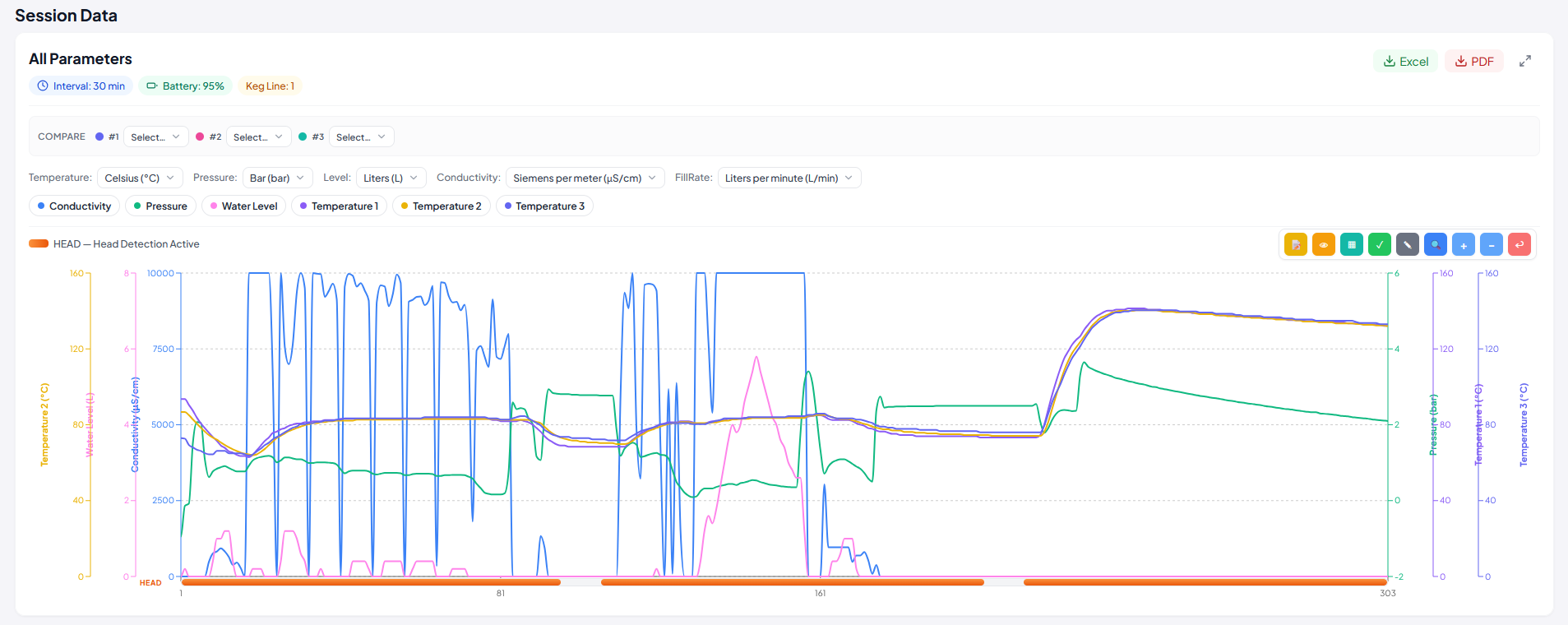
Keg cleaning verification is the use of integrated sensors to monitor and record cleaning-cycle parameters (temperature, pressure, conductivity level) inside a keg, providing data-based proof that a cleaning cycle was successful. Keg cleaning verification relies on kegs purpose-built for this application, equipped with integrated sensors that automatically monitor the critical parameters of the cleaning and sanitising process. Rather than depending on an operator manually checking a box, relying on memory, or trusting that the wash cycle ran as intended, the system captures real-time data such as:
This is precisely the approach behind ChecKeg, Checkology's quality control device built specifically for this purpose. ChecKeg uses six integrated sensors (three temperature sensors, a pressure sensor, a conductivity sensor, and a liquid level sensor) to record internal keg conditions during every wash cycle, streaming that data to the cloud in real time for reporting and historical analysis.
Why Keg Cleaning Validation has become a priority
Traditional keg washers automate the cleaning motion, but verifying that the process actually succeeded is a different challenge, one the industry has addressed with very different levels of sophistication. Smaller producers often still rely on trust: if the machine doesn't jam or throw a visible error, operators assume the cycle worked. In reality, many failures are subtle: a partially clogged nozzle, an under-diluted cleaning solution, or a cycle interrupted early can all go unnoticed without data to catch them.
Larger producers, on the other hand, have typically already adopted some form of keg verification, but often through legacy systems that are showing their age: fewer sensors, dated interfaces, and data that's technically "there" but hard to actually interpret or act on. Verification exists, but it doesn't deliver the clarity or confidence it should.
Alcohol-free (0.0%) and low-alcohol beers add an extra layer of risk when kegs are reused between fills. Any residual protein or yeast left from a previous batch of regular beer can affect flavour, trigger unwanted fermentation, or even introduce trace alcohol into a product marketed as alcohol-free. This makes full, homogeneous coverage of the cleaning and sanitising cycle critical, not just on the internal keg wall, but also on the spear, where residue tends to accumulate and is easy to miss with a visual check alone. Keg cleaning verification, confirming that temperature, pressure and conductivity thresholds were met across the entire internal surface, gives producers the assurance that a keg previously used for regular beer is genuinely safe and clean for a 0.0% or low-alcohol fill.
The consequences of getting this wrong aren't theoretical, regardless of scale. Residue from yeast, proteins, or bacteria left inside a keg can alter flavour, cause cross-contamination between batches, or put consumer health at risk. Food safety regulators take equipment sanitation seriously for exactly this reason: the FDA Food Code, for example, requires that sanitising solution concentration be accurately tested and maintained, not just assumed by eye (source: FDA Food Code Supplement, https://www.fda.gov/media/183271/download). In the EU, equivalent obligations exist under Regulation (EC) No 852/2004 on the hygiene of foodstuffs, which requires food business operators to keep equipment and surfaces in contact with food clean and, where necessary, disinfected, based on HACCP procedures (source: Regulation (EC) No 852/2004, Annex II, EUR-Lex, https://eur-lex.europa.eu/eli/reg/2004/852/oj/eng). For beverage producers or breweries of any size building their reputation on consistency, a single improperly cleaned keg can damage an entire brand.
Key Benefits of Sensor-Based Keg Hygiene Monitoring
1. Early detection of equipment issues
Sensors can flag deviations from standard parameters before they become a visible problem, for example a gradual drop in wash pressure signalling a worn pump, an air supply issue or valve issue.
2. Simplified compliance and auditing
A monitoring system automatically generates reports that can be presented to regulators or commercial partners, replacing manual documentation that's prone to errors or omissions.
3. Resource optimisation
Monitoring water, energy, and chemical usage on every cycle helps producers spot inefficiencies and cut operating costs without compromising cleaning quality.
4. Greater trust across the distribution chain
Distributors and bars receiving kegs can rely on documented proof that a container passed a validated cleaning process, reducing disputes over product quality at delivery.
FAQ
The bottom line
Keg cleaning verification turns a once-invisible, assumption-based process into something transparent, measurable, and auditable. As the beverage industry becomes increasingly focused on quality and safety, a solution like ChecKeg is becoming an essential tool for guaranteeing consistent product quality and supporting compliance documentation, from the brewery floor to the pint served at the bar.Want to see how sensor-based keg verification works for your business? Get in touch with our team or download the brochure to learn more.